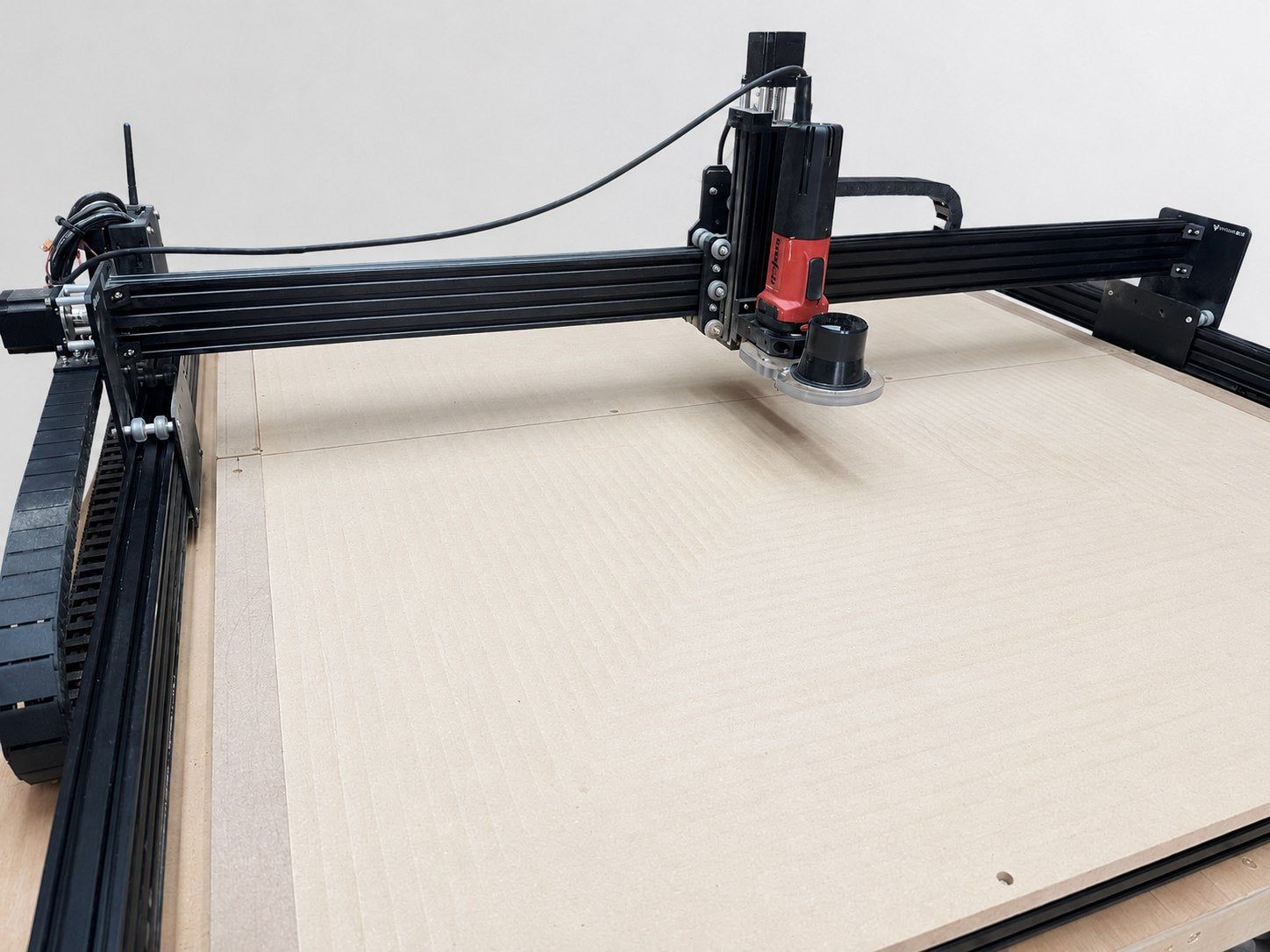
Wood to Spec reviews flat or sheet-based parts for CNC routing as one-offs, prototypes and small batches. A router can follow defined paths repeatedly, but the design still has to suit the material, available cutters, hold-down method and safe machining sequence.
Operations in plain English
| Term | What it means | What must be specified |
|---|---|---|
| Profile | Cuts around the outside of a part | Finished outline, side of line and critical dimensions |
| Internal cut-out | Removes a through opening | Opening geometry and corner requirements |
| Pocket or rebate | Removes material to a stated depth | Boundary, depth and reference face |
| Hole or slot | Creates a round or elongated feature | Size, centre position, depth and fit purpose |
| Engraving | Cuts a shallow line or detail | Artwork/path, depth intent and minimum legibility requirement |
These definitions describe processes, not confirmed availability for every geometry. See plain-language operation guidance.
Material and size qualification
Standard materials are MDF, moisture-resistant MDF and structural plywood. Material is qualified by exact grade, nominal thickness, stock source, part size and intended finish during the project review. The maximum stock size is 1220 × 1220 mm; the usable cutting area is smaller because workholding and safe edge clearance are required. Nominal sheet thickness must not be treated as an exact fit dimension; learn why material variation matters.
Tolerance is not a universal promise
Machine positioning, cutter condition, workholding, material variation and finishing can all affect the finished result. Critical interfaces should be identified and, where appropriate, tested with a coupon or prototype. A tolerance only becomes meaningful when its scope, measurement method and exclusions are stated. Specify a fit rather than assuming one.
Information for a CNC routing review
- the part’s purpose and overall dimensions;
- material preference or the performance/finish you need;
- quantity and whether parts repeat;
- a sketch, photo, PDF, vector or CAD export;
- depths and front/back orientation;
- mating hardware or components;
- dimensions or surfaces that are critical;
- any required grain/face direction;
- target packed size if postage cost matters.
Not automatically suitable
Three-dimensional sculpting, metal machining, structural certification, food-contact approval and toy compliance are not implied by this page. Fitting, installation and local delivery are not offered; completed orders use UK-mainland courier or postal dispatch. Very small details, deep narrow pockets and tiny loose parts may also require redesign or another process.
Turning vague cuts into defined operations
When a panel contains a profile, two openings, one pocket and engraved text, labelling every path as a “cut” leaves important decisions unresolved. The drawing should name each operation and depth so the scope can be checked and quoted.
Define the operation schedule
| Decision | Evidence to use | Consequence |
|---|---|---|
| Operation intent | Use a marked drawing to separate through features, blind depths and engraving. | CAM review begins from the intended finished geometry. |
| Material qualification | Name the required performance or exact board rather than assuming stock. | Tool, hold-down and finish decisions depend on the real sheet. |
| Critical feature | Mark the pocket depth and mating opening as functional. | Inspection focuses on what affects use, not every dimension equally. |
| Quantity route | Separate prototype, first order and possible repeat volume. | Setup and testing are not confused with an unapproved batch. |
Routing details that cause ambiguity
An open vector is interpreted as intentional geometry.
Supply a readable reference so accidental gaps can be distinguished from design openings.
The drawing omits which face contains a pocket.
Mark front/back and show a section view with depth from a named face.
Fine engraving is assumed possible because it looks clear on screen.
Review cutter access, depth, material and finish at full size; test the smallest representative detail.
A broad service description is used as acceptance.
Treat every file, material and quantity as subject to a written feasibility and quotation stage.
CNC routing enquiry checklist
- Include units and one check dimension.
- Distinguish finished geometry from notes and construction lines.
- State material, nominal thickness and acceptable substitutions.
- List operations and depths by part ID.
- Mark visible face, grain and mirrored components.
- Identify fits, hardware and inspection method.
- Provide prototype and production quantities separately.
CNC routing questions
Can a photograph be machined directly?
It can explain intent, but controlled dimensions and vector geometry are normally needed before toolpaths can be prepared.
Does profile cutting include sanding or finishing?
No finishing stage should be inferred. The quote must state where machining ends and who owns later preparation.
Why might a simple pocket increase cost?
A pocket adds depth decisions, toolpath passes, material removal and checking; another cutter may also be justified.
Confirm capability for your design
The quotation confirms the operation, material, thickness, usable part size, tooling and any test requirement for the active design. Exact board properties come from the current manufacturer or supplier information for the board being quoted.
Request a feasibility review
Send the part for feasibility review, or first compare one-off parts, prototyping and small-batch production.