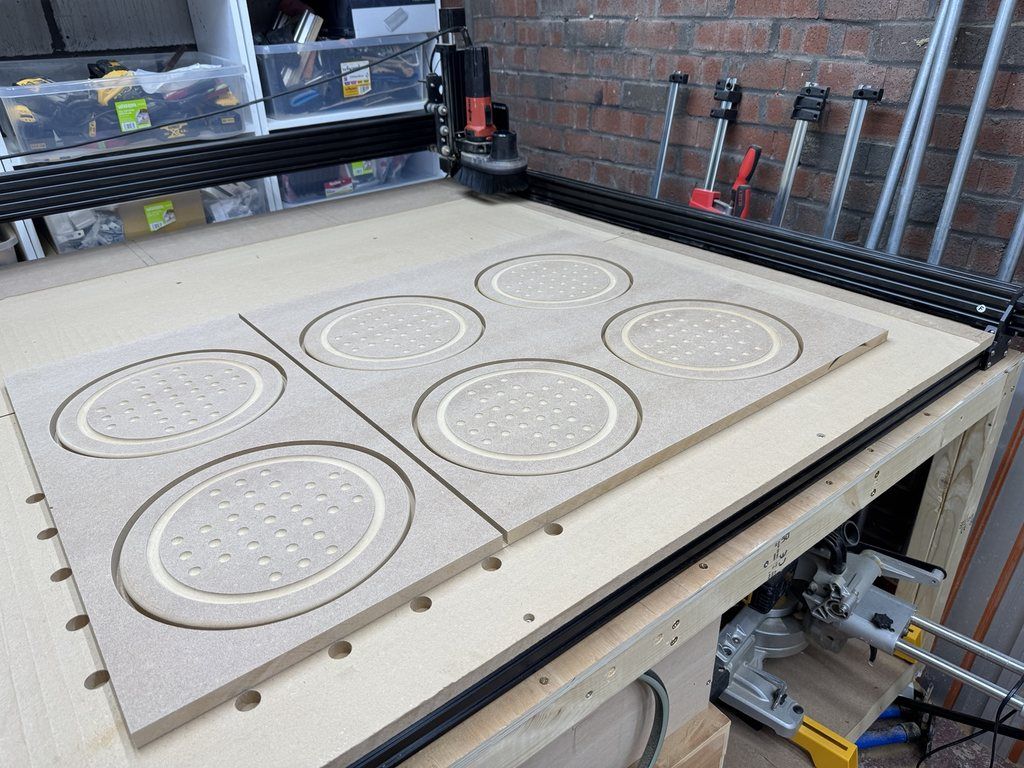
Small-batch CNC production should begin with approved geometry and a named revision, not an assumption that the latest email attachment is correct. Repetition can spread setup effort, but it also multiplies any unresolved error.
Before repetition
- confirm part IDs, quantities and revision;
- agree material and visible-face orientation;
- identify critical dimensions and inspection method;
- approve a sample or documented prototype result where needed;
- define acceptable natural material variation;
- confirm how parts are grouped, protected and posted.
Nesting and workholding
Parts need cutter clearance, material around hold-down zones and a safe strategy for staying in place. Better sheet yield is not simply shapes touching each other. Understand nesting, tabs and repeat-order control.
Batch checks
The inspection plan distinguishes critical-to-function features from cosmetic observations. The quote or approval record should name what will be checked and how, rather than relying on a general “quality controlled” statement.
Keep production and fulfilment counts aligned
For kits, record quantity at three levels: pieces per assembly, assemblies in the order and any agreed spare or replacement parts. A batch of twenty kits containing three different CNC parts is not simply “twenty pieces”. The parts list should also say whether components are loose, grouped by kit or packed by part type. That decision affects counting, labelling and the seller’s later assembly work.
Natural sheet variation and local defects need an agreed response. Define which appearance points are critical, how a non-conforming part is identified and whether another piece can be produced without changing the approved revision. Avoid permanent marks on visible faces unless they are part of the agreed product.
Repeat orders
A reorder is a new commercial instruction linked to an earlier approved revision. Confirm quantity, material, finish responsibility, packaging and any superseded files every time. Control quantities and revisions.
The controlled package for a batch review
Parts list, quantities, controlled files, target material, approved sample reference, critical checks, desired grouping and packaging/postage constraints.
Moving an approved prototype into a batch
For a repeat run after a successful prototype, two mirrored components and kit-based packing need explicit part IDs, quantities and orientation. The quote then confirms the active geometry, responsibilities and production scope.
Control the repeated parts
| Decision | Evidence to use | Consequence |
|---|---|---|
| Design freeze | Link every part ID to the accepted revision. | Prototype approval does not float independently of files. |
| Quantity structure | State pieces per kit and total kits. | Packing and machining counts can be reconciled. |
| Sheet orientation | Mark visible face, grain and mirrored pairs. | Correct shapes are not produced on the wrong face. |
| Batch acceptance | Define fit, count, identity and visible condition checks. | General quality language becomes an actionable record. |
Batch-control failures to avoid
A tighter nest compromises hold-down.
Balance yield with cutter clearance, small-part stability and safe operation order.
A material substitute appears during repetition.
Pause and review thickness, face, finish and fit before using another source.
Rejected or damaged pieces are not tied to part IDs.
Record exceptions by ID and quantity so replacement and root cause are clear.
A reorder overwrites the original deal.
Create a linked order with its own quantity and status while preserving the approved source record.
Small-batch specification checklist
- Confirm approved sample reference.
- Issue current BOM and revision index.
- State quantity per part and per kit.
- Mark material/face/grain.
- Name critical dimensions and sampling method.
- Define part marking or bag grouping.
- Confirm seller finishing boundary.
- Review packed size and postcode.
- Record substitutions and deviations.
Small-batch questions
What counts as a small batch?
There is no universal number; review quantity against setup, material, handling and commercial fit.
Does repetition remove setup cost?
No. It can spread some setup across more parts, while machining, material, handling and checks continue.
How should a changed reorder be handled?
As a new reviewed revision or scope, linked to the earlier record rather than described informally.
Confirm the active batch quotation
Wood to Spec focuses on one-offs, prototypes and small batches. Quantities above 50 can be reviewed, but this is not a high-volume manufacturing service. The quotation confirms material, quantity, checks, production stages and timing for the active revision.